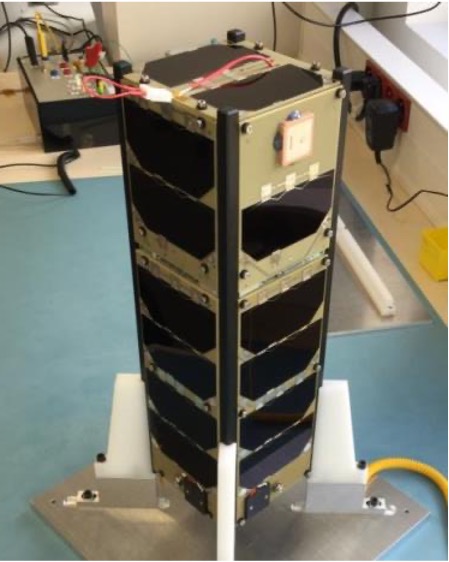




Collisions in orbit and satellite orbit decay have shown that orbital debris poses a danger to accessing space or a threat on the ground. A very promising solution currently being studied at CNES aims to clean up low-altitude orbits by injecting debris. The EntrySat mission aimed to place a 3U nanosatellite into low orbit.
EntrySat was the first nanosatellite project that CSUT was able to rely on. While the platform and ground segment are credited to ISAE-SUPAERO, the CSUT technical team had the opportunity to operate it. This project was partly funded by the European QB-50 program and the former CNES Janus program.
EntrySat was launched to the ISS on April 17, 2019, by an Antares rocket. It was injected from the ISS on July 3, 2019, using a Nanoracks system.
Unfortunately, after 10 days, contact was lost with the nanosatellite. It reentered and disintegrated in the atmosphere on August 10, 2021.